Kazuaki Tanahashi Publishes ‘Painting Peace: Art In Times of Global Crisis’ (2018)

Kazuaki Tanahashi kindly sent me his latest book from Shambhala Press: a retrospective review of his paintings accompanied by stories that invite the reader to become better acquainted with the good life of this wandering Berkeley-based artivist (activist artist).

Kaz Painting Peace Cover
Kaz’s book contains a chapter about his painting, Bristle Cone Pine, two scrolls that played a key role in our Mountains & Rivers Workshop.

The PDF via the link below contains the Table of Contents and the “Bristlecone Pine” chapter (pp. 192–97).

Kaz Peace Painting 2018 Bristlecone Pine

Kaz Bristlecone Pine Chapter layout

I’m enjoying the practice of perusing one chapter from Painting Peace each day.

Thank you, Kaz.

Mark Gonnerman Interviewed by Denis Pugenov on Teaching the Beats at Hunan University in China (Published in English and Russian, September 2017)

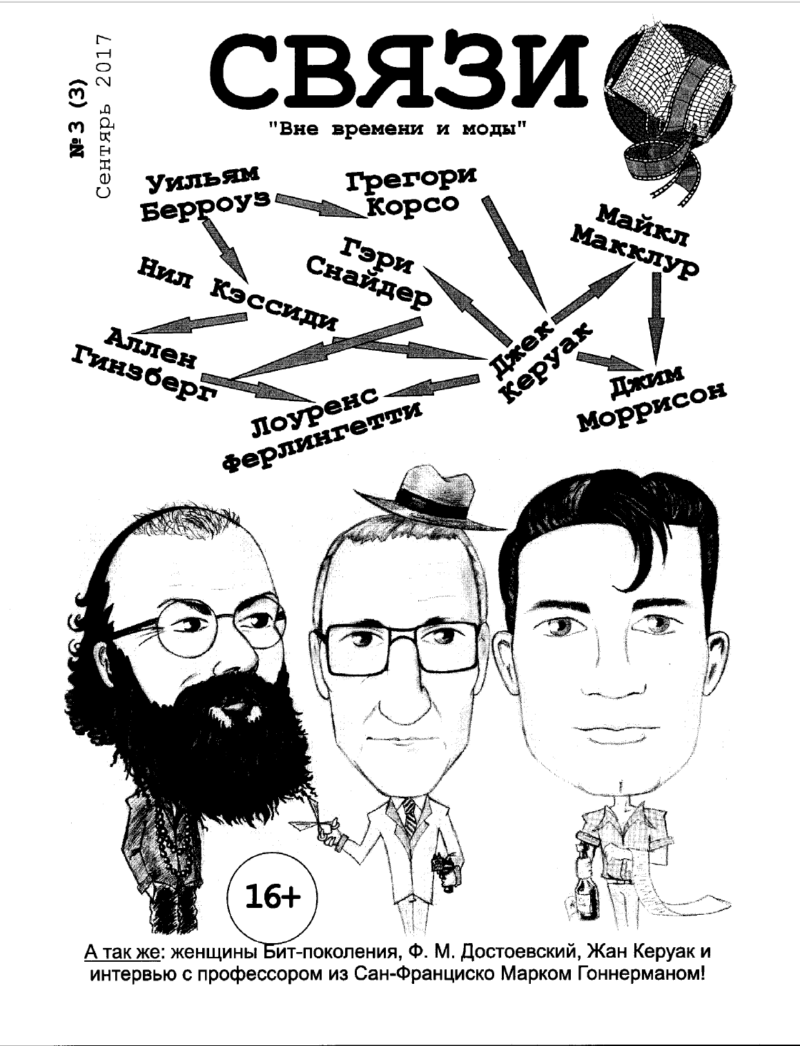
Mark Gonnerman was interviewed by Denis Punegov, the founding editor of the St. Petersburg zine, Svyazi, about teaching beat culture and literature and his experience with this at Hunan University in China. You may download the PDF of this article via the link below:

Denis Punegov, “War For Imagination [Interview on the Beats with Mark Gonnerman],” Svyazi [St. Petersburg (in English and Russian)] No. 3/3 (September 2017): 93–136. [PDF]

A Sense of the Whole reviewed by Justin Wadland in Rain Taxi 20/3 (Fall 2015)

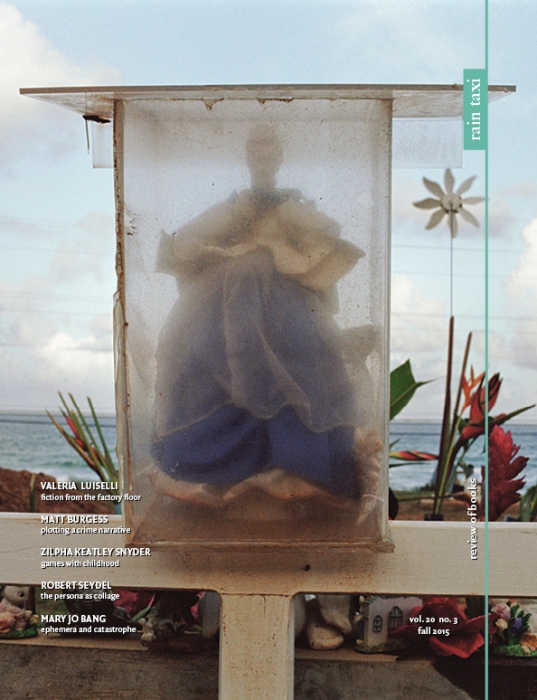
Justin Wadland reviews A Sense of the Whole in Rain Taxi 20/3 (2015): 8–9.

“Tucked in an appendix at the end of volume, another essay by Gonnerman titled “Fieldwork: Gary Snyder, Libraries, and Book Learning” offers a fascinating survey of the important place textual study has had in the poet’s life: ‘Contrary to what may be a popular misunderstanding of Zen Buddhist life, Snyder enjoys extraordinary book knowledge and knows how to use it.'”

Rain Taxi (Fall 2015 Table of Contents)

“Snyder envisioned the poem as a song of healing, and these essays make clear that this healing happens through a deeper awareness of the interdependence of all beings.”

                                                                                                 —Justin Wadland

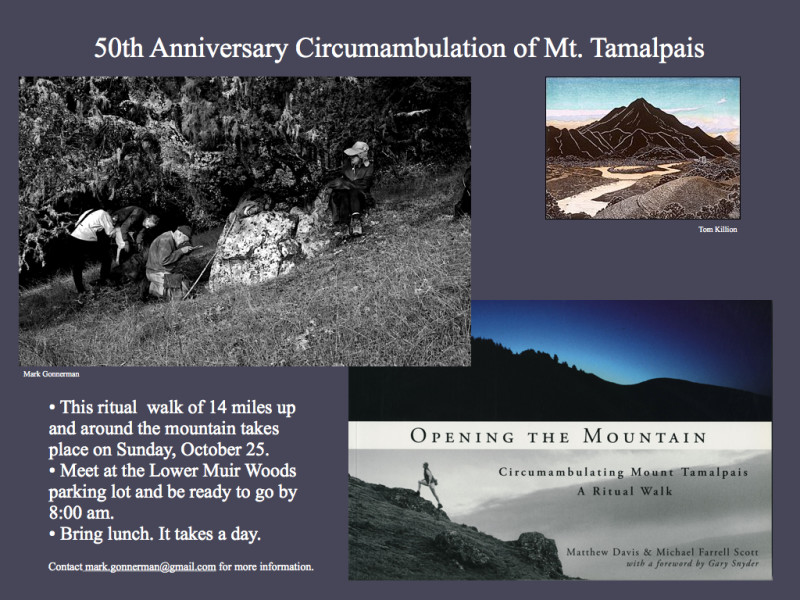
50th Anniversary CircumTam Announced | October 25, 2015

From Nicholas Triolo:

Hi there,

  I hope this message finds you all well. You’re receiving this message because, in some form or another, you’ve either expressed interest in joining or have been instrumental in helping guide the coordination of the 50th anniversary circumambulation of Mount Tamalpais on Sunday, October 25th, 2015 at 8am.
  Thanks to your gracious help, conversations and email communications, this event is shaping up to be a powerful one.
  Now, I’m aware that the ritual CircumTam typically happens on the equinox and solstice weekends, but it seems extremely fitting to honor the original October 22nd, 1965, walk by Snyder, Ginsberg, and Whalen with a special spiral walk on the Sunday closest to this date. I also feel it timely and necessary to honor the life of Matthew Davis and his lifelong dedication to this important ritual.
  Growing up in and around Mt. Tamalpais and having personally followed this circumambulation route’s history for years, this event means a lot to me, so please join us for some or all of this special day. Details below:
Basic Schedule: 
  • When: Sunday, October 25th, 2015. 8am-8pm
  • Where: Overflow parking lot at Muir Woods, by Redwood Creek.
  • Who: Everyone is welcome. I’ve only sent this list to the core group, but please share.
Detailed Schedule
  • 8:00a – 8:15a – Arrival and preparation
  • 8:15a – 8:30a – Welcome introduction
  • 8:30a – 7:00p – Walk (sunset is 6:19pm, though this could take longer; we will walk in silence except for lunch and the descent)
  • 7:15p – 7:30p – Closing talk
  • 7:30p – 9:30p – Dinner somewhere close by
What to Bring: 

You are all experienced CircumTam walkers, so you know what to expect!
  • Lunch and snacks
  • Something warm
  • Headlamp
  • Any personal items, prayer beads, etc.
  Thank you, again, for your help in making this a reality. I’ve spoken to most of you and have received great amounts of support and encouragement. I’m looking forward to meeting those of you I haven’t yet met.
  RSVP: If you could take a minute and respond to this message letting me of if you can make all of the walk, some of the walk, or cannot make any of it, that would be greatly appreciated. Also, if you have any recommendations or suggestions for making the event happen smoothly, please let me know. For those of you who have already made that clear to me, please disregard.
  Thanks again. I’ll look forward to your response, when time allows.
Wildly,
Nicholas Triolo


Gary Snyder and the XIVth Dalai Lama

Today is the Dalai Lama’s 80th rebirthday. When I hosted His Holiness at the Aurora Forum at Stanford on November 3–4, 2005,  I presented him with a copy of Mountains and Rivers Without End. I reminded him that the poet, Gary Snyder, and his traveling companions, Joanne Kyger, Allen Ginsberg, and Peter Orlovsky visited him at his headquarters in Dharamshala on March 31, 1962.

HHDL_SU_4NOV2005_NoBorder
His Holiness the Dalai Lama at Stanford on November 4, 2005. From left to right: Scotty McLennan, HHDL, Mark Gonnerman, Thupten Jinpa. His Holiness has just received the gift of Gary Snyder’s ‘Mountains and Rivers Without End.’

In his record of his travels in India, Gary writes:

The Dalai Lama doesn’t spend all his time at the ashram; in fact he had just returned from a tour of south India, Mysore, where a few Tibetan refugee settlements are. And the last thing I heard (since I got back to Japan) is that he’s going to set out and do some real Buddhist preaching over India, and maybe Europe and America eventually, spinning the wheel of the Dharma. He is at the least a very keen-minded well-read man, and probably lots more than that. Also, he himself is still in training—there are the “Senior Gurus of the Dalai Lama,” the most learned of Tibetans, who keep him on a hard study schedule and are constantly testing and debating with him (Passage Through India [San Francisco: Grey Fox Press, 1983], 84).*

* An expanded and photographically illustrated edition of Snyder’s account of his half-year in India was published by Shoemaker & Hoard in 2007. This report was first published in Caterpillar (19/3) in 1972.

July 4th, Mythic Patterns, and Proceeding by Clues

In “Proceeding by Clues,” his contribution to A Sense of the Whole, Robert Hass oberserves (p. 153):

On the next page [of Snyder’s “The Making of Mountains and Rivers Without End” (M&R 153–158)] he tells us, usefully, that he began the poem on April 8, 1956, and though he doesn’t claim to have finished it on April 8, 1996, he does describe giving a party on that date to celebrate the completion of the project. Like Louis Armstrong’s claiming to be born on the 4th of July, this suggests a desire to see life through mythic patterns, or to make them. It’s also an interesting take on Gary’s precision and discipline.

Today, on the 4th of July, I am reading Robin Cheng Tsing Tsai’s article on “The Ethics of Translation”  (Ariel: A Review of International English Literature 40 [2009], 63–88) and she says the “initial conception” of Mountains and Rivers Without End occurred on April 4, 1956 “during a long talk with Hasegawa Saburo on Sesshu.” Both Tsai and Eric Smith (whom he cites) reference page 88 of Eliot Weinberger’s Paris Review interview with Snyder as the source of this information.

Wait! On April 4? So I go to Eric Todd Smith’s excellent Western Writers Series booklet, Reading Gary Snyder’s Mountains and Rivers Without End (Idaho: Boise State University Western, 2000), and see that on page 11 he does indeed say April 4, 1956.

Did Gary change the date from April 4 to April 8 as part of “a desire to see life through mythic patterns, or to make them”? And how did I not notice this before? Strange. So I go to my file cabinet and pull out my photocopy of the Paris Review interview. I find no reference to Hasegawa, nor do I find page 88. What’s going on? After a bit of confusion, I deduce I failed to copy the page immediately preceding the interview title page (“Gary Snyder: The Art of Poetry LXXIV”). What was on that page?

I then find the online version of the interview and see a link that says, “view a manuscript page.”* I click it and up pops what must have been on p. 88 from Gary Snyder’s journal, with a caption that reads, mistakenly, “A manuscript page from Gary Snyder’s Mountains and Rivers Without End.”
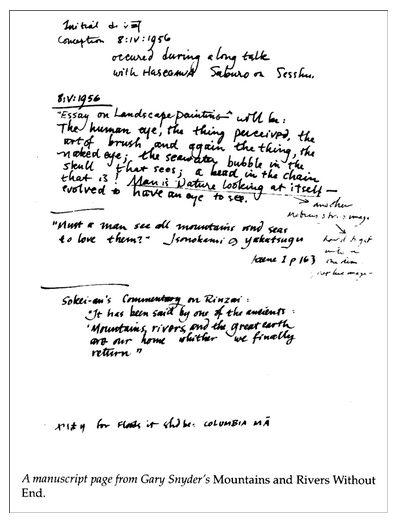
GSJ_ParisReview_8.IV.56_Hasegawa

Ah! All’s well. There was just a misreading of the date: 8:IV:1956 is April 8, 1956: Shakyamuni Buddha’s rebirthday, celebrated as hanamatsuri in Japanese. This is celebrated in most of East Asia on the 8th day of the fourth month in the Chinese lunar calendar. However, Japan adopted the Gregorian calendar during the Meiji Restoration and so the designated (mythic) date is April 8 there and on Turtle Island.

• An audio file of Eliot Weinberger’s interview with Gary Snyder for the Winter 1996 Paris Review is available on YouTube.
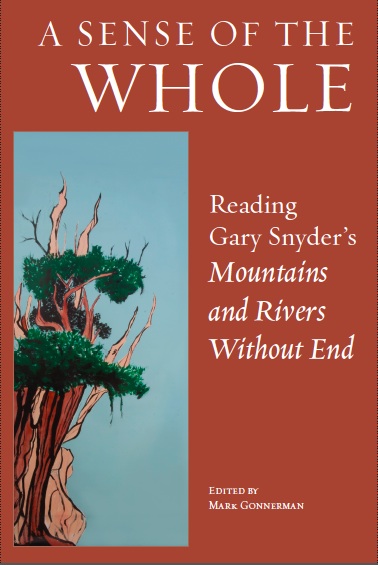
 

Back Cover Quotation: Robert Hass

On the back cover of A Sense of the Whole you’ll find this quotation from Robert Hass, Poet Laureate of the United States from 1995–97:

That [Mountains and Rivers Without End] is a meditative exercise in looking is crucial to the long poem as a book of instruction and embodiment of knowledge, for its imagination of a transformation of American consciousness, and, implicitly, of our politics, and the ways we interact with the world.

This is from Hass’s brilliant discussion of how to read Snyder’s poetry, available in A Sense of the Whole:

Hass, Robert. “Proceeding by Clues: Reading Mountains and Rivers Without End.” In A Sense of the Whole. Ed. Mark Gonnerman, 143–202. Berkeley: Counterpoint Press, 2015.